
Ever put an X in a curriculum map and wondered what it actually tells you? Or, perhaps more importantly, what it tells the person reviewing the course?
I’ve spent considerable time developing and reviewing university courses, and one frustration has remained remarkably consistent: we collect vast amounts of curriculum information but often struggle to see how it all fits together. Course learning outcomes, unit learning outcomes, graduate capabilities, assessment tasks and weightings are carefully documented, yet understanding how they support learning across an entire degree can mean switching between multiple Word documents, spreadsheets and institutional systems.
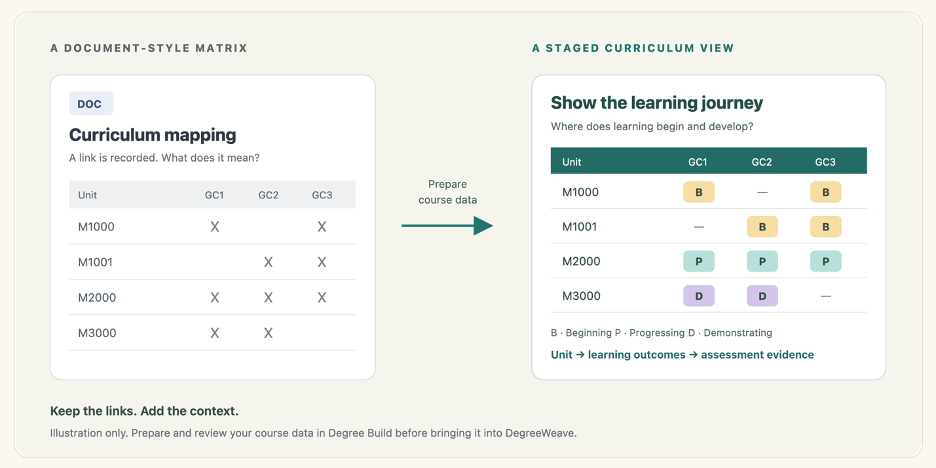
A curriculum map might show that an outcome is addressed in five different units, but what does that really mean? Does it show that students are steadily deepening their understanding, facing increasingly complex assessments, and getting opportunities to practise before they’re expected to demonstrate their capabilities? Or does it simply show that someone has linked two pieces of curriculum information?
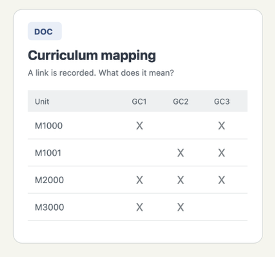
An X in a box rarely answers those questions, especially when the reasoning behind the decision is hidden. Considerable thought may have gone into designing how students will develop a particular capability, yet the curriculum management system offers little opportunity to communicate that thinking. In other cases, mapping can become an exercise in meeting a requirement. On paper, however, these two approaches can look remarkably similar.
From Frustration to Development
This frustration led me to start developing a curriculum mapping application, initially called CourseWeave. I began with the Bachelor of Screen Media, a degree I knew well, to explore how assessment tasks connected to unit learning outcomes, how those outcomes contributed to course learning outcomes, and how graduate capabilities developed across the degree. Rather than viewing these relationships in separate documents, I wanted to bring them together so users could move between the details of individual assessments and the broader structure of a course.
I wanted to explore progression, not just alignment. It wasn’t enough to know that a graduate capability appeared in several units. I wanted to understand where students began developing it, how expectations evolved as they progressed, and where they were expected to demonstrate their learning. Two units might address the same capability, but their contributions could differ considerably depending on the assessment’s complexity, the level of independence expected of students, and where the learning occurs in the degree.
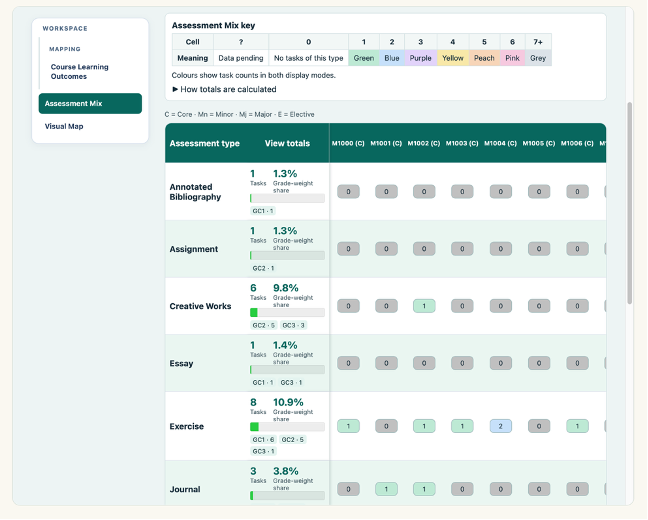
I also wanted to understand the broader pattern of assessment across a course. How often were different assessment types used? Did students encounter a reasonable range of approaches, or did certain formats dominate their experience? When an assessment type appeared repeatedly, did it support increasingly sophisticated learning, or simply ask students to repeat similar tasks? The more I explored these questions, the clearer it became that curriculum mapping was only one part of a much larger challenge. We also needed better ways to design, organise and manage the information being mapped.
When One Solution Leads to Another
What began as an effort to make curriculum mapping more meaningful has grown into something much larger than I first imagined. As I developed the first application, I realised the issues I was addressing went beyond how we visualise a degree. They also touched on course design, the development of individual units, and the relationships between them. Improving one part of the process inevitably raised questions about another.
There was little point in creating a sophisticated curriculum mapping tool if entering and maintaining information was still unnecessarily complicated. Improving the way we designed individual units would have limited impact if we couldn’t easily see how they fit into the broader course. What I had first imagined as a single application was becoming a much more connected approach to educational design.
This led to Mori, a growing ecosystem of digital tools built around a simple idea: educational design should be connected, not fragmented.
The name Mori draws on the idea of a forest, where individual elements grow and develop while remaining part of a larger, interconnected environment. I liked this as a way of thinking about education. A degree is more than a collection of units, just as a unit is more than a collection of assessments. Each element has its own purpose, but its real contribution becomes clearer when we understand how it connects to everything around it.=
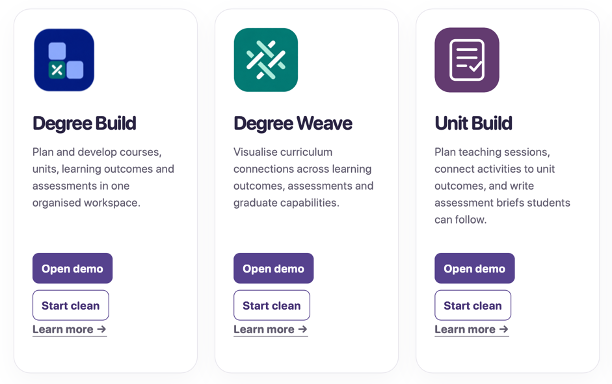
Mori now brings together three complementary applications, each supporting a different stage of the educational design process.
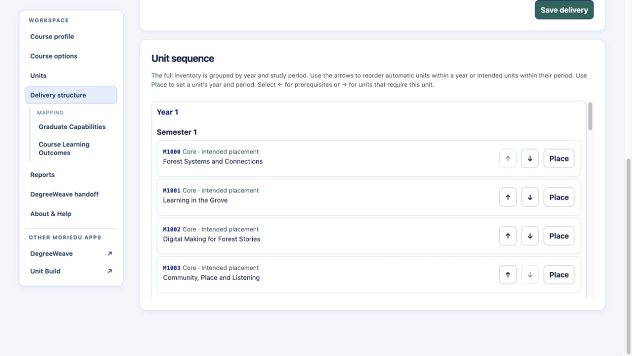
Degree Build focuses on the bigger picture, offering a space to develop and organise an entire course structure, including its units, learning outcomes and assessments.
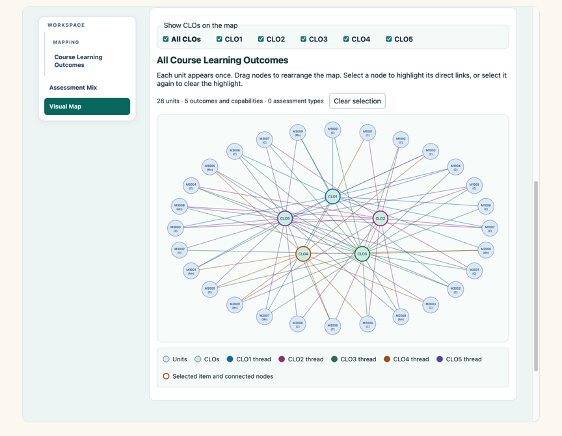
Degree Weave connects these perspectives, enabling educators to explore and visualise how assessments, unit learning outcomes, course learning outcomes and graduate capabilities relate across a degree.
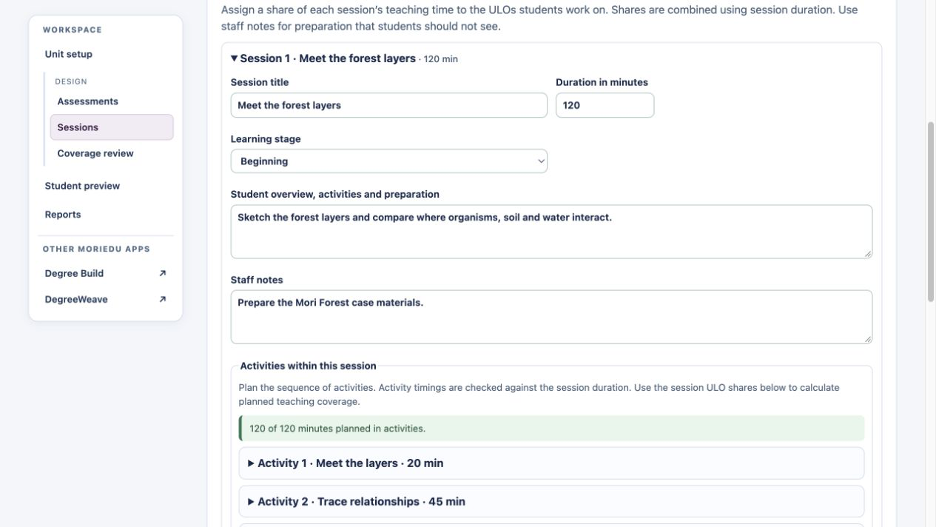
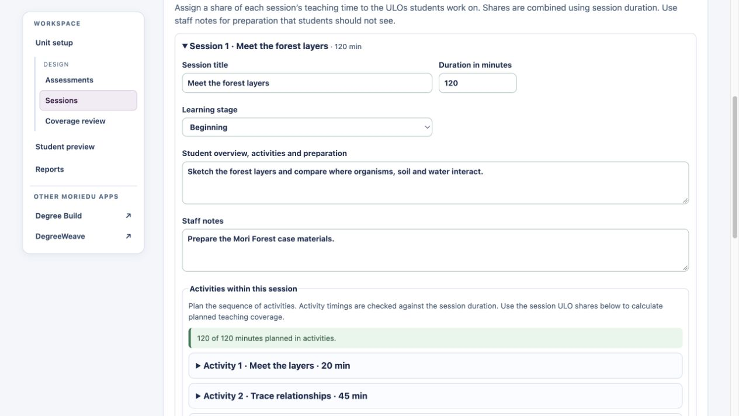
Unit Build focuses on individual units, helping educators develop learning outcomes and design assessments.
What interests me is not simply what each application can do on its own, but what becomes possible when they work together. Rather than treating course design, unit development and curriculum mapping as separate administrative activities, Mori aims to integrate them into a more connected process. Information developed in one context should inform decisions in another, allowing educators to move between the detail of an individual assessment and the broader learning journey of a student.
Of course, connecting information doesn’t automatically create a coherent curriculum. That still takes academic judgment, discussion, and careful design. But perhaps we can build tools that make those conversations easier, surface relationships that might otherwise stay hidden, and help us spend less time navigating documents and more time thinking about learning.
Seeing What a Curriculum Map Cannot Always Show
Consider critical thinking as a graduate capability. A traditional curriculum map might show that it appears in several units across a degree, but those connections reveal little about the learning students are expected to do. In first year, students might identify and compare different perspectives. In second year, they might evaluate evidence and justify decisions. By third year, they could be expected to independently develop and defend an argument in a complex professional context.
All three units contribute to critical thinking, though at different levels. Degree Weave uses the concepts of Beginning, Progressing,and Demonstrating to make these expectations visible throughout a course. This offers a way to see where learning is introduced, how it develops, and where students are expected to demonstrate increasingly sophisticated capabilities. The goal isn’t to reduce curriculum design to another set of boxes, but to make the academic decisions behind them easier to examine.
The same principle applies to assessment design. A degree featuring numerous presentations isn’t necessarily a problem: they may give students increasingly sophisticated opportunities to develop communication skills, progressing from short, structured activities to complex professional presentations that require independent research and critical judgement. However, if every presentation assesses essentially the same capabilities at the same level, it’s worth asking whether students are genuinely progressing.
Visualising assessment types and their weighting across a degree offers another way to start these conversations. It helps course teams spot patterns that may not be obvious when assessments are considered only within individual units. Repetition may reflect purposeful scaffolding, unnecessary duplication, or simply a preference for familiar assessment formats. A visualisation cannot determine which explanation is right, but it can help educators identify where further investigation and academic judgement are needed.
There is also an opportunity to consider curriculum design from the student’s perspective. Academics often develop and teach individual units, but students experience them as part of a much longer learning journey. Along the way, they encounter different assessment formats, expectations, teaching approaches, and opportunities to develop their capabilities. What feels coherent within one unit may not feel coherent across an entire degree. Viewing the curriculum as a connected whole allows us to consider not only what we intend students to learn, but also how they experience that learning over time.
Building Tools Without Being a Programmer
Another aspect of this project particularly interests me: I’m not a software developer. I came to Mori with a background in multimedia design, curriculum design, assessment, course leadership, and academic professional learning. I understood many of the problems I wanted to solve and had ideas about how the applications should work, but I didn’t have the programming expertise to build them myself.
I’ve used ChatGPT as a programming and development assistant, describing the educational problems, identifying what information needs to be represented, testing the applications and their visual and interface design, and deciding what needs to change. The AI has helped turn those requirements into working code, taking me from an idea to a functional prototype that I can continue refining through testing. The process has involved considerable experimentation, revision, and occasional frustration, especially when a change meant to improve one feature causes an unexpected problem elsewhere.
What interests me most is how this process expands what educators can create. Ideas that might once have stayed in a notebook, required substantial funding, or depended on access to a software development team can now be explored as functional prototypes. This doesn’t mean anyone can immediately build reliable, production-ready applications, or that software development expertise is no longer needed. It does, however, give educators the opportunity to experiment with solutions to problems they encounter in their own practice.
I would argue that disciplinary and pedagogical expertise is even more important here. AI can help produce code, but it cannot independently determine whether an application demonstrates good visual and user-experience design (I saw some terrible examples), sound curriculum design, meaningful educational relationships, or information that supports good academic decision-making. These judgments still require an understanding of teaching, learning, assessment, and the institutional contexts in which education takes place.
Perhaps generative AI is opening up another interesting opportunity. Much of the discussion in higher education has focused on how students and academics use AI within existing teaching and learning practices. But what potential does it have to help educators create entirely new tools? Rather than asking only how AI might support our current approaches, we could also consider how it might help us rethink the systems and processes we have come to accept.
Where to Next?
Mori is still developing. The next step is to move beyond examples from my own courses and explore how useful these tools might be for other educators. I’m especially interested in whether they help course coordinators, unit coordinators, learning designers, and academic teams identify relationships that might otherwise remain hidden in existing curriculum documentation.
For example, can someone trace an assessment task through its learning outcomes to understand how it contributes to the degree as a whole? Can a course team see where a graduate capability is introduced, developed and demonstrated, and assess whether expectations for students increase appropriately? Can an overview of assessment types spark useful conversations about repetition, variety and progression? And can designing an individual unit be more clearly linked to the broader course?
These are questions I want to explore through testing, not outcomes I can claim the applications have already achieved. I’m interested not only in whether the tools work technically, but also in whether they support meaningful conversations about curriculum design and help educators make more informed decisions.
Ultimately, Mori isn’t about replacing academic judgment or automating curriculum design. It’s about making the information we already create more accessible, connected, and meaningful. If we invest considerable time in designing learning experiences, our curriculum systems should help us understand and communicate those decisions, not just simply record that a relationship exists with an X in the box.
What began as frustration with putting an X in a box has evolved into an exploration of how educators can design better tools for themselves and others. It has also reminded me that innovation doesn’t always start with new technology or a grand vision. Sometimes it begins with a familiar problem, a moment of frustration, and the belief that there must be a better way.
I would love for you to explore the development of Mori and its applications at MoriEDU.org.
Five Questions to Consider
- Does your curriculum map demonstrate progression, or simply record alignment? When an outcome appears across multiple units, can you explain how students’ learning becomes more sophisticated?
- How easily can you trace an assessment task through the broader course? Can you identify its contribution to unit learning outcomes, course learning outcomes and graduate capabilities?
- What does your assessment mix reveal about the student experience? Are repeated assessment types providing meaningful opportunities for development, or are students completing similar tasks without increasing complexity?
- How connected are your unit and course design processes? When an individual unit is developed or revised, how clearly can educators see its relationship to the broader degree?
- What frustrations in your own educational practice could become opportunities for innovation? With the possibilities of AI-assisted development, could you create a tool that addresses a problem you have previously accepted as simply part of the way things are done?