

For the past few years, much of the debate about generative AI in higher education has focused on written assessments. The essay emerged as a key concern because tools like ChatGPT can generate proficient written responses quickly and at scale, challenging many traditional assessment assumptions.
We have invested significant time contemplating the implications. How can we determine if a student authored an essay? Is it necessary for students to disclose AI assistance? Should we revise the task, revert to exams, incorporate oral assessments, or focus more on process demonstration? Numerous solutions have been suggested, yet it remains challenging to assert that higher education has effectively addressed the issue.
There is no consensus on what authentic written assessments should look like with readily available generative AI. Institutions, disciplines, and individual academics continue to adopt different approaches. As that debate persists, a new wave is approaching.
One way to respond to generative AI is to rethink the assessments we assign to students. If AI can produce an essay, then students might need to show their understanding through different methods. Portfolios, projects, performances, presentations, and creative artefacts can offer more comprehensive evidence of their knowledge and skills.
Exploring these approaches is justified because a portfolio reflects development over time, unlike a single submission. Creative work pushes students to demonstrate knowledge, make decisions, and solve problems in ways difficult to capture through an essay alone. But we must be cautious not to shift from one assumption of authenticity to a different one without careful consideration.
AI is also transforming creative practice, prompting us to reconsider some assessment methods that are just starting to be introduced.
What Happens When AI Can Edit the Video?
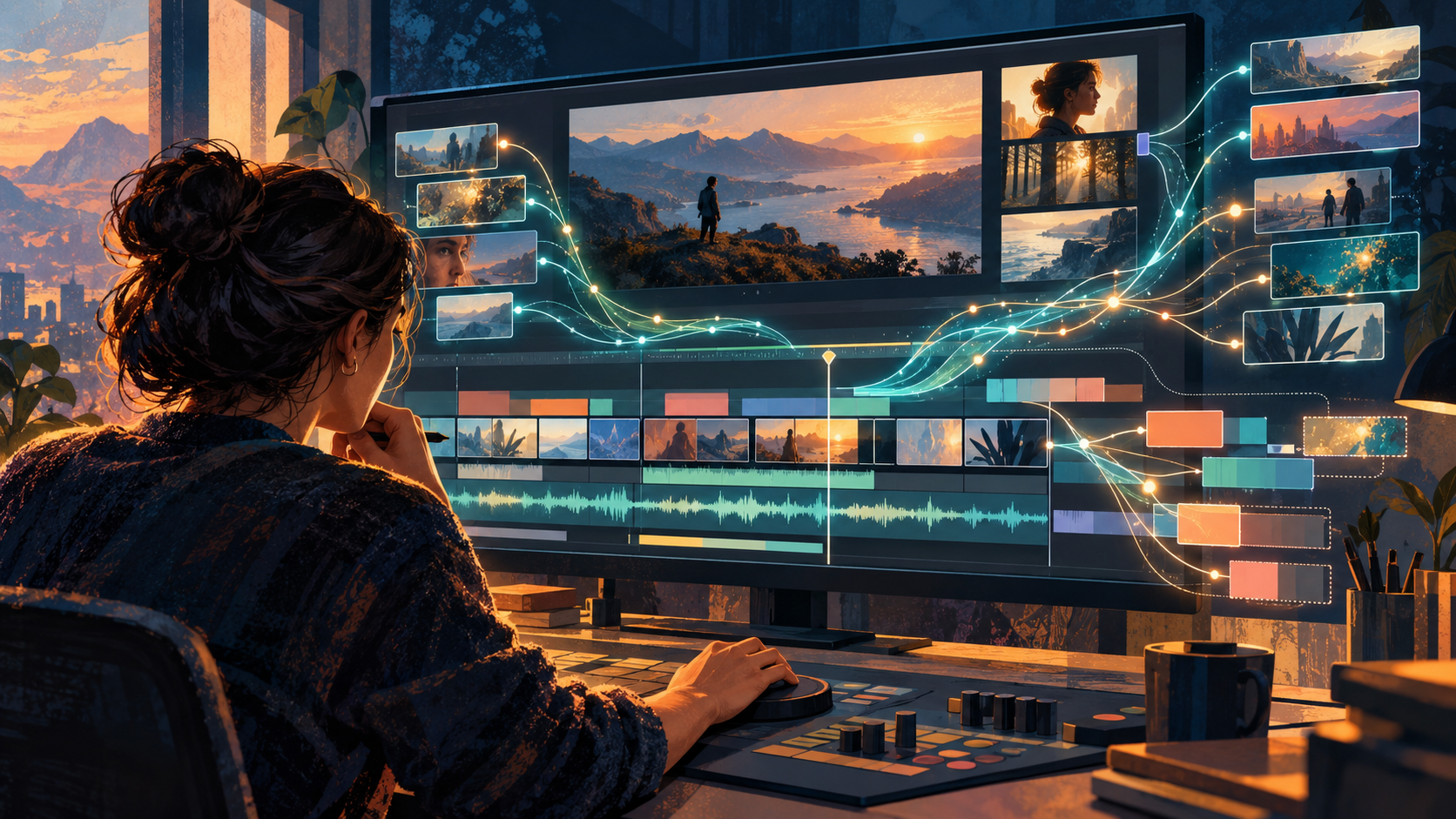
As Course Chair of the Bachelor of Screen Media at Victoria University, I see this shift as a direct challenge to how we design and assess creative learning. Blackmagic Design’s DaVinci Resolve, professional video editing and post-production software, offers a useful example. Its AI assistant integration allows external assistants to interact with Resolve through natural-language instructions. AI is no longer sitting outside the creative application merely offering advice about what an editor might do. It can now participate in parts of the workflow itself.
Current tools cannot fully replace every aspect of an editor’s practice (yet), and their control and automation remain limited. However, the direction of development is important. Just a few years ago, the main concern was that AI might generate a student’s explanation of an edit. Now, the focus shifts to AI actively participating in the editing process itself. For a degree that emphasises demonstrating learning through creative work, this raises important questions about the connection between the final product and the student’s skills.
This question goes beyond screen media to include design, audio, photography, and other creative fields. If a student submits a well-crafted creative artefact, what can it reveal about their learning? What insights can we gain into their technical skills, creative judgement, and ability to understand why certain decisions are effective?
Creative Practice Is Facing the Same Question
There may have been an understandable sense that creative disciplines were somewhat shielded from issues related to written assessments. For example, a student might use ChatGPT to help write an essay or a script, but tasks like making a film, designing an object, editing a sequence, mixing sound, or producing a portfolio were still considered separate challenges. Now, that clear separation is increasingly difficult to maintain.
AI-generated images have already impacted visual practices. AI tools can now create and modify voices, sounds, and music. Video generation technology keeps advancing. Editing platforms include features like automated transcription, reframing, colour adjustments, masking, and media organisation. Resolve’s integration marks another step toward AI’s direct involvement in production.
This doesn’t mean creative practice vanishes or that students can click a button to get a finished piece. Instead, it suggests the final artefact might become less dependable as a reflection of what the student can truly do. This issue is quite familiar: it echoes the challenge higher education faces with essays.
One risk is that people might respond to AI-generated writing by simply replacing the essay with a different output, assuming that authentication issues are settled. While a video, podcast, design, or portfolio can be valuable, their worth shouldn’t rely solely on the belief that AI cannot generate or significantly contribute to them.
A portfolio full of polished artefacts isn’t necessarily stronger evidence of learning than an essay if we can’t understand how those artefacts were created. A technically skilled edit provides less insight into a student’s abilities if software can perform many of the tasks that once demonstrated competence. Therefore, creative practices may need to take on some of the challenges that written disciplines currently face.
What Were We Actually Trying to Assess?
These tools prompt us to consider a key question: when assigning students to edit videos, what should they learn? Is it about rearranging clips on a timeline, mastering a specific software command, or applying transitions and audio tweaks? While some of these skills remain important, students need enough technical understanding to grasp the tools of their field.
However, technical skills constitute only a part of the broader creative process. Editing also requires judgement. Why should one shot succeed another? How does an earlier cut affect a scene’s emotional effect? Does the sound align with the image? Is the pacing suitable for viewers? Can the editor identify when a sequence fails and decide what needs adjustment? As AI handles more tasks, students may need to improve their ability to evaluate and understand the reasoning behind these decisions.
It is tempting to conclude that the answer is simply to assess process rather than product: ask students for drafts, screenshots, journals and explanations of every decision. Making the process visible is valuable, but it can turn creative work into an administrative task where students spend as much time demonstrating their work as creating it.
AI can support the process by generating reflections, rewriting development notes, and assembling project documentation after the fact. However, evidence used to authenticate artefacts cannot be automatically considered genuine. Higher education has yet to solve this issue for essays, and we should avoid assuming there’s an easy fix for challenges in creative practice.
What Does Creative Capability Look Like Now?
AI might prompt us to rethink the dynamic between the student, the tool, and the work itself. Imagine two students tackling the same editing task: one performs each step manually, while the other uses an AI assistant to produce an initial sequence, then identifies weaknesses, adjusts instructions, rejects decisions and reconstructs sections to craft a better final piece. Which student shows more skill? That question is no longer straightforward.
As professional editors more frequently adopt AI-supported tools, prohibiting students from using them entirely could result in assessments that don’t accurately reflect professional practice. Yet allowing unrestricted use without reevaluating the assessment criteria risks producing final artefacts that poorly indicate individual capabilities. This ongoing tension is poised to become a central challenge in assessment within creative fields.
But the question is not only how students use these tools. It is also who can afford to use them. In my own experimentation with ChatGPT and DaVinci Resolve, working through an AI-assisted editing workflow has placed substantial demands on my usage. Sustained use can mean paying for greater access. Access to the software alone therefore does not necessarily give students equal access to the workflow.
If these assessment methods are permitted or promoted, students’ ability to use them might be partly influenced by their access to resources. Some students could have more chances to experiment, revisit instructions, and improve their work, while others face restrictions sooner. It’s important to evaluate whether variations in the quality of submissions stem from differences in learning and creativity or from unequal access to the tools involved.
What Does the Artefact Demonstrate?
Higher education continues to discuss issues like essay detection, authentication, redesign, academic integrity, oral assessments, portfolios, and proper AI integration. There is no definitive model yet. However, technology has advanced beyond just writing and now includes tools students use to design, edit, and create.
This does not negate the value of creative or authentic assessment. However, it indicates that authentic assessment isn’t just about altering the submission format. The key issue is what evidence the assessment offers regarding a student’s learning and how confidently we can interpret that evidence.
For many years, higher education has used submitted artefacts like essays, designs, or portfolios as indicators of student learning. We have inferred students’ understanding based on the quality of these artefacts. However, AI is complicating this inference process. We have yet to resolve this issue for written assessments, and creative disciplines might need to address it sooner. How should assessment adapt when AI can produce the artefact?
Questions for Reflection
- If AI can increasingly contribute to written and creative outputs, what evidence of learning is required?
- Have we been too quick to treat portfolios and creative artefacts as solutions to authentication issues?
- Which parts of creative practice are students expected to do themselves, and which tasks can reasonably be performed with AI?
- How can we evaluate creative judgement without needing students to record and verify each step?
- As AI becomes more integrated into professional practice, how can we create assessments that accurately reflect industry standards and showcase individual learning?
Latest Posts
- We Haven’t Solved the Essay. Now AI Can Make the Creative Work

- The Convenience of a Number: Why Are We So Infatuated With Grades?

- What If Today’s Problem Was Yesterday’s Solution?

- Where Does the University Campus End? Rethinking the Campus as an Ecosystem

- If Assessment Ends at the Grade, What Was It For?


