
This piece began with a LinkedIn post.
An article from Future Campus was being shared that was largely positive. But one line, drawn from Andrew Norton’s, recent analysis of undergraduate demand, gave me pause. In the Future Campus piece, it noted; “On a discipline level, all non-STEM fields attracted fewer applications in 2025 than they had in 2010, with a notable plunge in the creative arts.”
Norton’s charts below show a fifteen-year comparison. As Norton notes “To make the charts below easier to read I converted the varying absolute application numbers to an index with base year of 2010. The science index is 1.5, meaning that in 2025 it had 50% more applications than in 2010”.
As we can see in the non-STEM course graph there is a notable plunge across the creative arts. Compare this with the STEM courses, which have all increased in the same period.
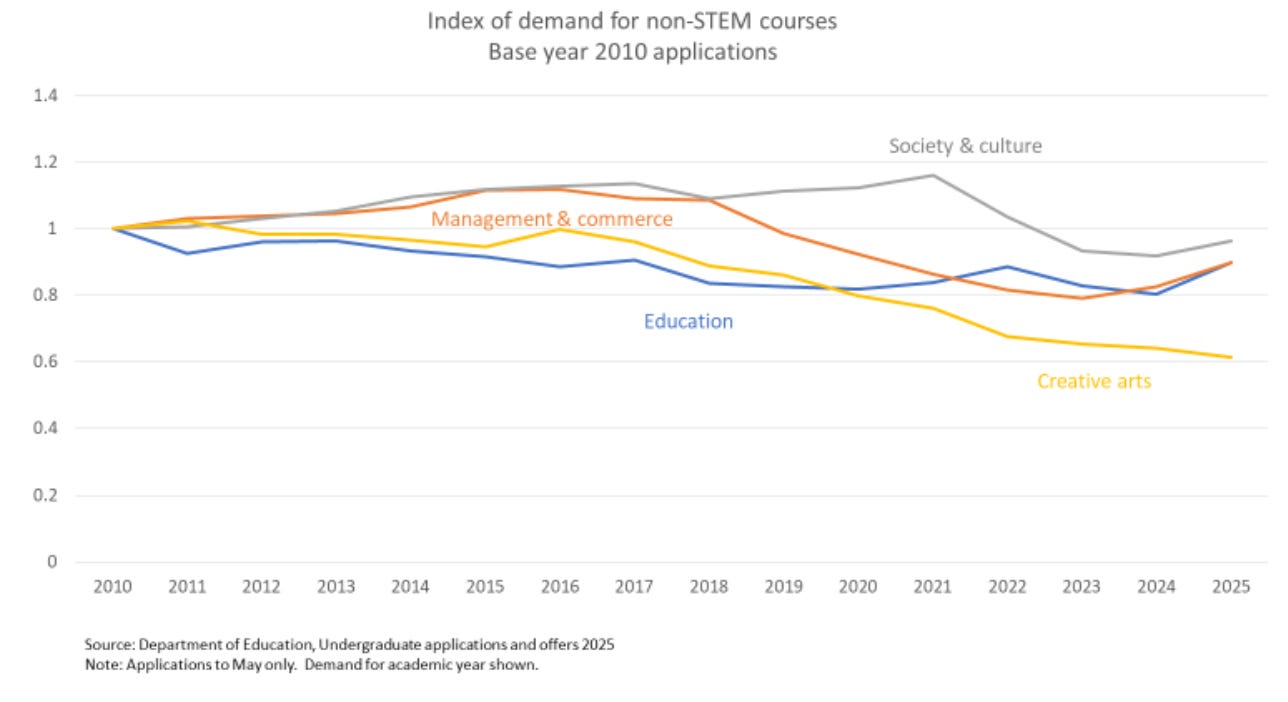
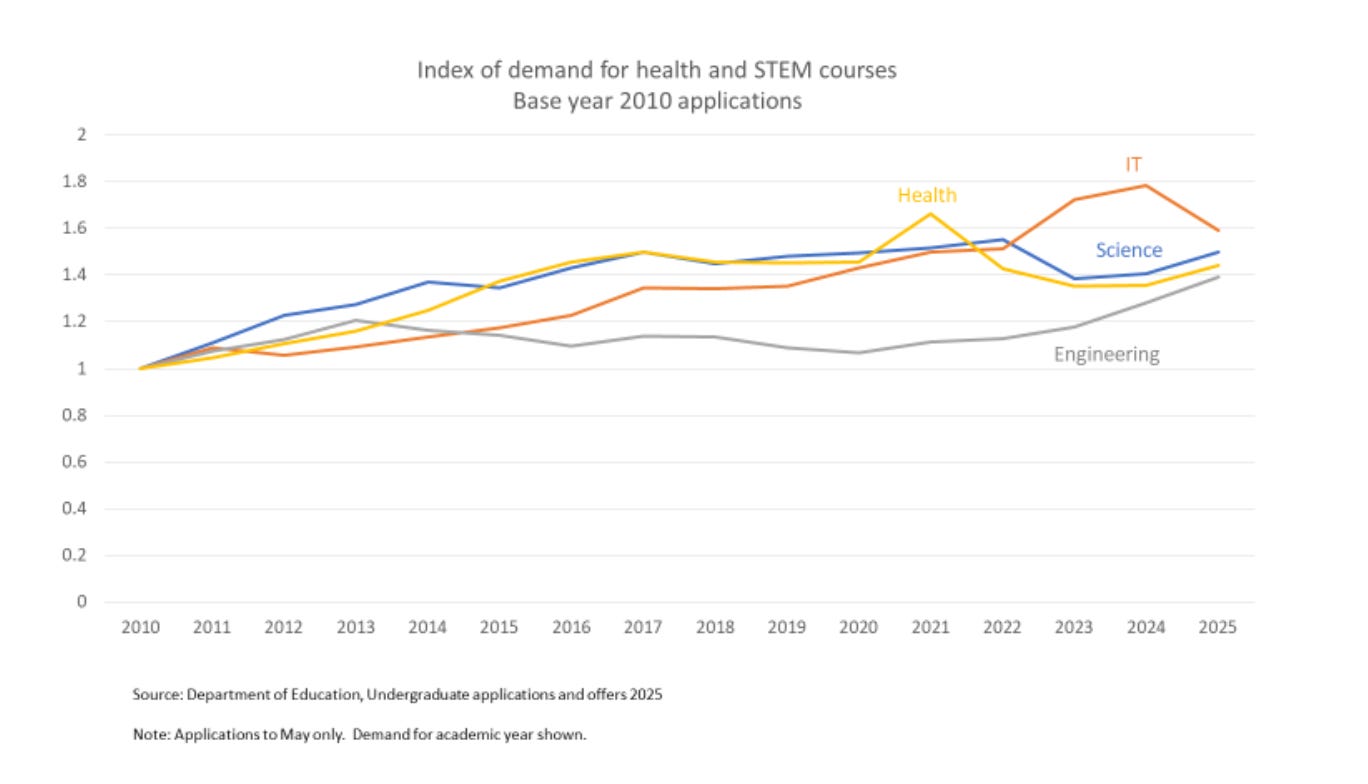
For the creative arts, this is not a short-term fluctuation. It spans funding reforms, demographic shifts, technological transformation, pandemic disruption, and industry volatility. If applications in creative disciplines are lower in 2025 than in 2010, a structural factor may be at play.
And that brings us to cost. Not only financial cost, but institutional and cultural cost as well.
It’s Not “Us Versus Them”
Let me clarify what this article is not. It is not an argument against STEM. It is not an argument against Education.
Many of my colleagues I work closely with are in the Education discipline. I witness firsthand the complexity, responsibility, and social significance of their work. We urgently and sustainably need more teachers. Education underpins our social cohesion, economic resilience, and civic life. Supporting teacher training and strengthening the education workforce is essential.
The question is not whether Education deserves support. It unquestionably does. The question is whether supporting one vital discipline requires pricing signals that make another comparatively harder to access.
However, creative disciplines are integrated into Education. Future teachers learn media literacy, storytelling, and creative practice to design engaging classrooms. Business students utilise digital storytelling. IT students work on screen projects together. Creative subjects serve as majors, minors, and electives across various degrees. The relationship isn’t oppositional; it’s interconnected.
The question is whether funding architecture needs to operate as a zero-sum structure, where strengthening one vital discipline increases the financial barrier to another.
When Policy Prices a Discipline
In 2021, the Job-ready Graduates reform reshaped student contribution bands through the Higher Education Support Amendment (Job-ready Graduates and Supporting Regional and Remote Students) Act 2020 (Australian Parliament).
Some fields became more affordable. Others became more expensive. Media, screen production, and many creative arts programs were placed in higher contribution bands. Education degrees were positioned as a national priority and made comparatively less expensive.
By 2025, student contribution amounts for Creative Arts disciplines sit at roughly $9,300 per year for a full-time study load (one EFTSL). Education sits at approximately $4,600 per year for a full-time load.
These are annual costs, not the total degree costs. However, over a typical three-year undergraduate program, the difference accumulates considerably. Annually, the cost of studying Creative Arts is effectively double that of Education. Contribution bands may appear technical. But they send signals. And signals shape decision-making.
Importantly, these pricing structures do not only affect students enrolled in standalone Creative Arts degrees. Because creative subjects are embedded across programs, shifts in demand influence the breadth of what students in Education, Business, and other disciplines can access as part of their studies.
Cost is rarely contained within one column of the course handbook.
The Debate Is Not Settled
The pricing structure remains politically contested. In 2024, the Australian Greens introduced a bill proposing to halve the cost of arts degrees, arguing that current settings disproportionately burden students pursuing creative disciplines.
At the same time, the Australian Universities Accord Final Report reopened broader questions about system design, access, and national capability.
Whether framed as affordability, workforce alignment, or cultural investment, the debate ultimately centres on the same issue:
What kind of higher education system are we incentivising?
The Industry Was Changing Too
Pricing reform did not occur in isolation, especially when we consider Media degrees. The media industry has undergone a significant transformation over the past decade. COVID shutdowns in 2020 paused production across Australia. The subsequent surge in streaming led to record levels of production between 2021 and 2023. Afterwards, there was a period of contraction and consolidation. Commissioning cycles became unpredictable. Employment remained project-based. Technological shifts accelerated, from virtual production environments to AI-assisted workflows.
At the same time, the rise of the creator economy has changed the way people enter the media industry. TikTok, YouTube, podcasting, and streaming platforms enable content creation without needing formal degrees. The perceived need for a traditional screen production qualification has altered for some.
In this context, the financial cost of a Media degree is interpreted alongside industry volatility. Students do not evaluate price in isolation. They evaluate price against perceived opportunity.
Institutional Drift
Universities are ecosystems. They adapt to enrolment flows. Infrastructure follows demand. Media production programs are resource-intensive. Studios, editing suites, specialist equipment, and technical staff are not low-cost operations. If enrolments soften while cost structures remain fixed, sustainability pressures emerge.
Because Creative Arts and Media programs are woven across degrees, contraction does not remain confined to a single faculty. It affects the richness of the broader curriculum.
Over time, institutional character shifts. Not suddenly. Not dramatically. But slowly. A smaller cohort. An elective withdrawn. A studio repurposed. Costs build up.
What Is the Cost of Creativity?
Perhaps the deeper question is not simply whether Media enrolments have declined. It is what we lose if and when creative disciplines become increasingly difficult to sustain.
Creative education shapes how a nation tells its stories, interrogates its values, documents its history, and imagines its future. Media degrees cultivate journalists, producers, editors, and storytellers. The professionals who make culture visible and interpretable.
When participation decreases, consequences follow. We lose diversity of voice. We lose regional storytelling capacity. We lose creative experimentation. We lose infrastructure that supports local production instead of imported narratives.
And we lose the cross-disciplinary enrichment that creative study brings to other degrees.
Policy settings and contribution bands may seem administrative. But they shape who steps forward, who hesitates, and who concludes that the financial risk outweighs the possibility.
If fewer students opt for creative pathways, especially in Media, the effects go beyond enrolment figures. They influence whose stories get told. They impact whose perspectives are heard. They shape the cultural confidence of our institutions and of our nation.
The cost of creativity is not measured only in dollars. It is measured in voices not heard, stories not told, and futures not imagined.
And the direction we are heading will not be decided by rhetoric alone. It will come from what students select next and from the policy settings that quietly influence those choices.
Reflection:
- If pricing signals influence student choice, what sort of university ecosystem are our current contribution bands promoting?
- How should we assess the success of funding reform… Through workforce alignment alone, or by the variety of disciplines supported within the institution?
- What happens to cross-disciplinary richness if creative majors, minors, and electives contract over time?
- If Media enrolments continue to soften, what does that mean for Australia’s long-term storytelling capacity and cultural confidence?
- Are we comfortable with the possibility that cost, rather than curiosity or capability, is increasingly shaping who studies creativity?
Latest Posts
- Beyond Four Walls: Rethinking Learning Spaces in Higher Education

- The Assessment Illusion: Why Precision in Grading is a Myth

- Innovation in Higher Education: Beyond Technology and Buzzwords

- The LMS Divide: Should Online and In-Person Students Have Different Access?

- Teaching as Performance vs Teaching as Design